Methane release from the East Siberian Arctic Shelf and Abrupt Climate Change
Russian Academy of Sciences, Far Eastern Branch, Pacific Oceanological Institute, Vladivostok, Russia "Opening the Arctic", Washington, Nov.30th-Dec.2nd, 2010.

Russian Academy of Sciences, Far Eastern Branch, Pacific Oceanological Institute, Vladivostok, Russia "Opening the Arctic", Washington, Nov.30th-Dec.2nd, 2010.
First active leak of sea-bed methane discovered in Antarctica.
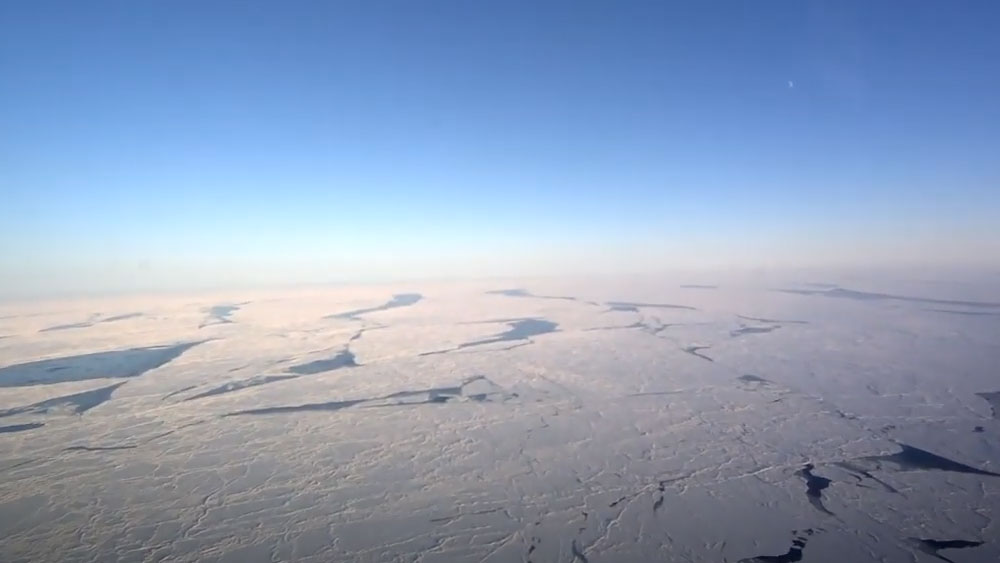
The East Siberian Arctic Shelf has received more attention in recent years in regards to a potential contribution of the greenhouse gas methane, for the global methane budget, from several different sources.
In conditions without oxygen, such as at the bottom of a lake or the sea, decomposition turns organic matter into methane, rather than carbon dioxide.
Excerpts from an episode of History Channel's "Mega Disasters" series.
Deep in the Arctic Circle, in the Messoyakha gas field of western Siberia, lies a mystery. Back in 1970, Russian engineers began pumping natural gas from beneath the permafrost. The field continues to power Norilsk today.
A giant hole near a lake, surrounded by forest, filmed by an approaching helicopter.
Methane still contitutes a large fraction of US greenhouse gas emissions.
Denis Postle provides a thought provoking view on Earth and our society.