
How hemp emerged as an unexpected structure material
The material’s supporters emphasize its non-toxic qualities as well as its resistance to mold, fire, and infestation.
Cannabis sativa, often known as the plant of the thousand and one molecules, has a long and varied history. It has been used as a traditional medicine, to make rope, to fill holes in ships, and as a source of textile fiber for clothing.
However, hemp, a non-psychoactive form of cannabis, is now being promoted for something even more ambitious: building blocks for homes that might circumvent some of the logistical, financial, and environmental drawbacks of concrete.
In addition to issues brought on by hard surfaces and poor insulation, or R-value, qualities, the cement industry is accountable for around 8% of carbon dioxide emissions that warm the world.
On a small scale, there are exciting possibilities, such as the use of hemp mixed with lime to make low-carbon, more climate-healthy construction materials, but the hunt for large-scale alternatives has so far produced few successes.
The Guardian: “There’s an enormous growth potential in the US for hemp fibre used for building and insulation,” said Kaja Kühl, an urban designer and the founder of youarethecity, a design and building practice based in Brooklyn, New York. “Hemp was only legalised in 2018, but now industrial hemp is following the first wave of CBD and cannabis.”
Kühl, who participates in a Columbia University project to assist in implementing environmental projects in the Hudson Valley, finished building two cottages on a farm in upstate New York last summer using hemp-lime, also marketed as hempcrete. The material is mostly utilized for interior walls and thermally efficient insulation because the blocks are not load-bearing.
The two rental cottages, which are situated on the Wally Farms experimental farming incubator and showcase sustainable building methods, are built with timber and prefabricated hempcrete bricks to minimize their carbon footprint. They are constructed in accordance with upstate rural architecture.
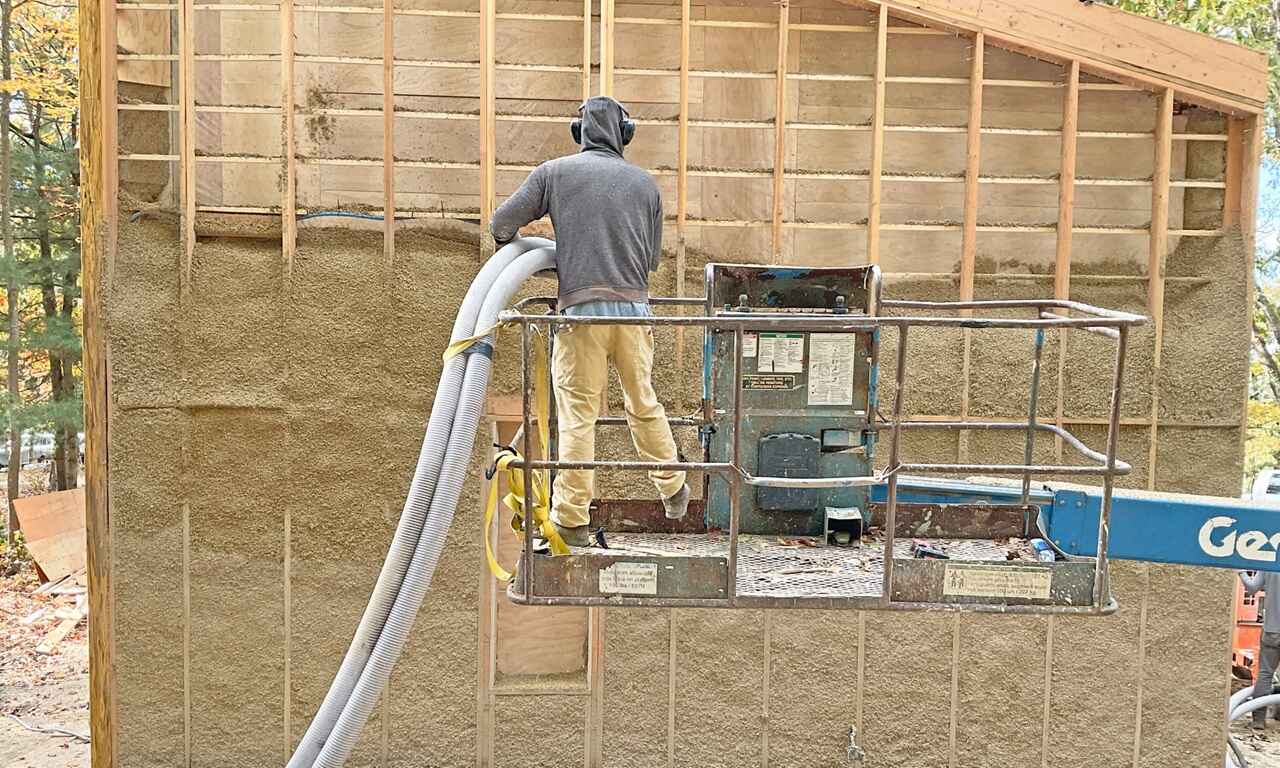
The walls of the Wally Farms guesthouses were filled with hemp, Hempcrete. Photograph: Laszlo Kovacs
Building material to reduce carbon footprint
According to Kühl, there is a nascent community of activists, designers, and fabricators that see bio-based building materials as a means of significantly lowering the upfront or embodied carbon footprint of materials that, in certain cases, make up 80% of their carbon lifecycle.
The Guardian: Since hemp, a type of Cannabis sativa, combines strength and quick cultivation, its potential as a building material has been recognized for generations. Its capacity to absorb more than twice its own weight in carbon, twice as quickly as conventional forestry, has gained attention in recent years. According to some estimations, photosynthesis in hemp may absorb up to 15 tonnes of CO2 per hectare. The UN emissions gap of 23 gigatons of CO2 per year would be closed if hemp production occupied just 25% of the agricultural area currently used for dairy and cattle.
“Choosing materials that sequester a lot of carbon before they become construction materials can be very beneficial in this quest to get to carbon-neutral by 2050,” Kühl said, pointing out that the hemp that is used is the hurd, from the inner stem, and not the bark that is used for paper or rope.According to the Rapid Transition Alliance, it was first developed in France in the 1980s as a method of adding thermal performance to medieval timber frame buildings that has its roots in pre-Christian Gaul. Proponents of using hemp in construction (they tend to prefer the term hemp-lime to hempcrete because it contains no concrete) talk up its non-toxic and mould, fire and infestation-resistant properties.
Without extra added chemicals
Most attractive, said Tim White of Texas Healthy Homes, is that no chemicals are added. “Modern construction industries are a toxic cocktail,” White said, “and many of our customers are looking for a non-toxic house. This material is almost carbon-negative,” he said.
“There are no petrochemicals involved at all, so once we get rid of the toxin-load of the materials, we can make healthy homes for people to live in – and you’ve loaded your deck to make a healthy indoor environment built using historic building materials with a track record that’s thousands of years old.”
U.S. Policy
White sources hemp from South Bend Industrial Hemp at Great Bend, Kansas, using a monolithic construction like an adobe or earthen dwelling, with no openings in the walls. Following the legalization of hemp production in 2018, the company launched the first facility of its kind in 2021.
However, a lot of fresh information needs to be taught because the US sector is still in its infancy. Similar to marijuana, hemp was effectively banned in 1937, and attempts to resurrect the business have been made long after memories of its production, processing, and ready market have faded.
The Guardian: “Everyone wants us to be 50 years down the road with systems and education,” White said. “But we’re finding that this knowledge of historic materials doesn’t exist any more.”
But things are a bit further along in Europe. For instance, the Haverhill hemp houses in Suffolk, UK, are a few decades old, yet the Pierre Chevet sports center, close to Paris, France, was built lately with hempcrete. The global market for hempcrete is expected to expand at a rate of 16% annually between 2021 and 2028, while the global market for green building materials is expected to reach $419 billion by 2026.
However, the hemp-lime sector will have to contend with the well-established building sector, which places a premium on cost and control. on an attempt to advance the sector, White is also teaching workshops on natural building techniques. With adobe floors, no drywall, paint, or calk, Texas Healthy Homes aims to create homes that seem like any other, without resorting to futuristic, Arcosanti-style, or geodesic dome designs.
The Guardian: “I understand where the market is,” he said. “You’re going to want to sell this thing, so you’re going to want flat walls. I don’t want anyone coming to me in 10 years saying they’re trying to sell their home. Well, yeah dude, make it flat …”
Tao Climate, a business that grows hemp on a large scale using state-of-the-art technology, said last week that it has partnered with Hemp Technology of Ukraine to use hempcrete to build houses for 170 internally displaced people and war orphans in Lviv. The project is expected to remove over 1,000 tonnes of CO2 and is a finalist in Elon Musk’s XPRIZE for carbon removal, which offers a $100 million incentive prize.
The Guardian: “We have proven that our model works under the harshest of circumstances,” Tao Climate’s Felix Roick said in a statement. “What we have achieved in Ukraine is remarkable. We’re effectively removing CO2 from the atmosphere while enabling sustainable housing for millions of people worldwide. It’s a win-win for the planet and humanity.”
Hemp in French agriculture
In recent years, hemp farming has emerged as a viable and appealing alternative in French agriculture. Hemp has long been disregarded in favor of more conventional crops, but because to the efforts of local farmers’ associations and environmental awareness, it is today experiencing a renaissance. Farmers around France are working together to create structured hemp production networks that satisfy financial, environmental, and agricultural criteria.
The Roannais region supports the production of hemp
Cannabizeu: Thanks to the dedication of local farmers and the backing of regional organizations, the hemp industry is expanding in the Roannais agglomeration. Roannais region is in the Auvergne-Rhône-Alpes area. Recently, two local farmers have made investments in hemp cultivation: the Boire de Perreux farm and Antoine Cherrier in Saint-Martin-d’Estreaux.
Study
- U.S. hemp insulation emits −0.198 kg CO2 eq. when including biogenic carbon.
- Environmental impact varies regionally due to climate, technology, agronomy, and energy sources.
- Hemp has lower environmental impact than EPS and XPS, but ranks behind fiberglass and rockwool without biogenic carbon.
Biogenic carbon refers to carbon derived from biological sources, which is part of the fast domain of the global carbon cycle characterized by rapid exchanges between the atmosphere and the biosphere. It is distinguished from fossil carbon and can be temporarily stored within the anthroposphere through the use of biomaterials in construction projects.
Related
- Could your next home be made of hemp?
- Built of hemp, France’s Pierre Chevet sports hall may become a carbon sink
- EU-backed initiative in France aims to strengthen hemp textile supply chain
- France makes key move towards legalising medical cannabis
- Switzerland will consider legalising recreational cannabis use
About the Author: CLIMATE STATE

POPULAR
COMMENTS
- The risk with the path to a hothouse Earth | Climate State on Climate Tipping Points Existential Threat to Our Life Support Systems
- Robert Schreib on Electricity generation prices may increase by as much as 50% if only based on coal and gas
- Robert Schreib on China made a historic commitment to reduce its emissions of greenhouse gases
- Lee Nikki on COP30: Climate Summit 2025 – Intro Climate Action Event
- Hollie Bailey on Leaders doubled down on fossil fuels after promising to reduce climate pollution