
Copernicus: Forest fires cause record levels of CO2 emissions
Tagesschau: In 2025, forest fires in Europe released more CO2 (Carbon Dioxide) than ever before since measurements began. According to the Copernicus Earth Observation Service, the fires in Spain and Portugal accounted for the largest share.
Around 12.9 megatons of carbon
The amount of emissions in 2025 so far has been estimated to be 12.9 megatons, as a result from forest fires in Europe up to September 15th, according to estimates by the EU’s Copernicus Earth observation program.
This already significantly exceeds the previous record of 11.4 megatons set in 2003 and 2017. The figure could rise, since the forest fire season in Europe is not yet over.
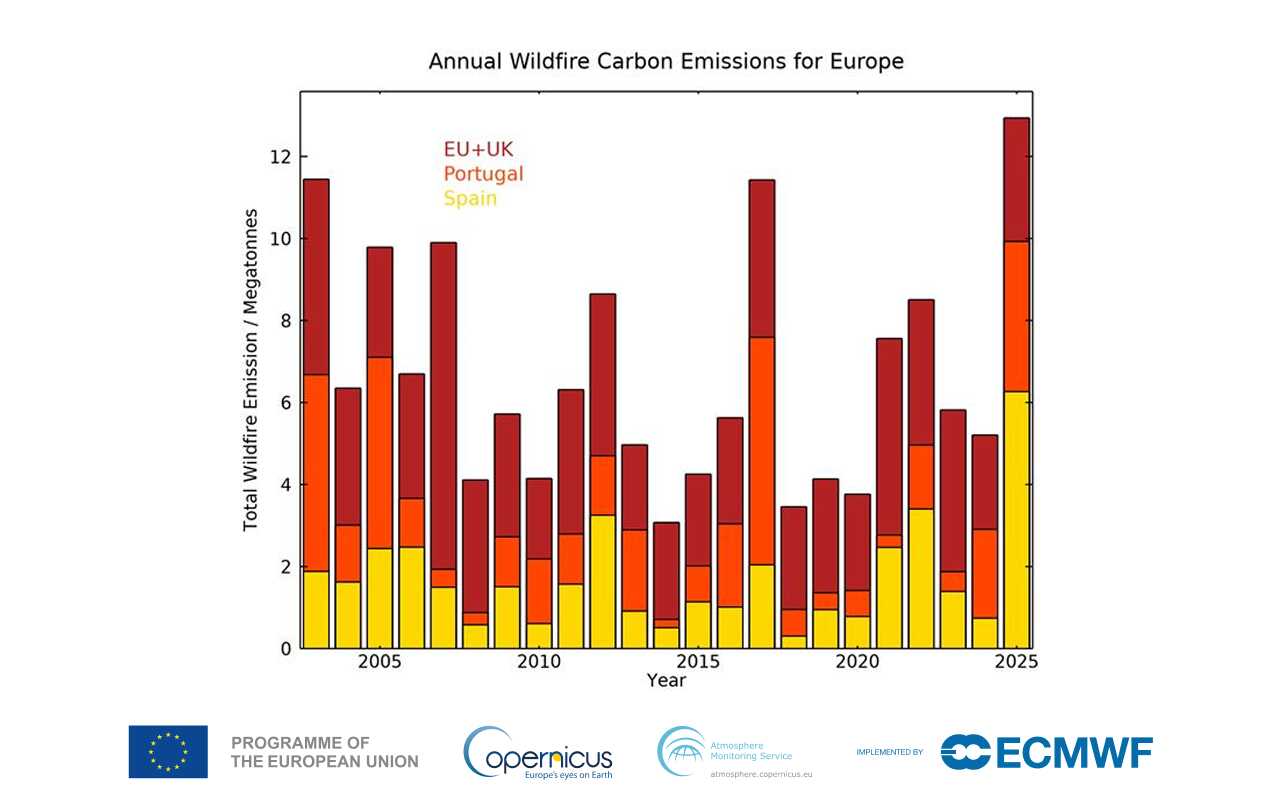
Annual total wildfire carbon emissions for the European Union and the United Kingdom up to 15 September. Spain (yellow) and Portugal (orange) contributed with the vast majority of emissions in 2025 after the extreme wildfires during Augus. from the CAMS Global Fire Assimilation System (GFAS). Credit: CAMS / ECMWF
Copernicus attributed around three-quarters of the total emissions in 2025 to the fires in Portugal and Spain in August. In addition, there were large fires in Turkey, Cyprus, and the Balkan states. Southeastern Europe also experienced one of its most active seasons in recent years.
Extreme wildfires season in Europe
The main driver of the significant increase in wildfire emissions in Europe were the fires in the Iberian Peninsula in mid-August. The total emissions in the region, which had been below average up until early August, shifted drastically in only one week, with fire emissions from Spain and Portugal making up around three quarters of the European total.
Turkey, Cyprus and some Balkan countries experienced significant fires early in the season. Wildfire activity persisted as the summer advanced, and as a consequence southeast Europe saw one of the most active wildfire seasons in recent years, mainly driven by a series of fires in the Balkans during July.
“Throughout summer there were different regions within Europe that experienced very intense wildfire activity, mostly in the south of the continent. The emissions resulting from these wildfires have been the largest for any summer in at least the last 23 years.
Given the potential risk that these emissions pose to the air quality locally and across borders in terms of exposure to fine particles and other pollutants, it is fundamental to keep monitoring these events globally and using the resulting data for developing better mitigation and adaptation strategies.” – Laurence Rouil, Director of the Copernicus Atmosphere Monitoring Service
High levels of Saharan dust and ozone
Copernicus: Canadian wildfires continued to burn intensely into early September reaching the second highest annual emissions only behind those of 2023.
The main fire activity was observed in British Columbia, Yukon Territory and Northwest Territories rather than in the prairies provinces of Saskatchewan, Manitoba and Ontario as was the case in previous months. Large plumes of smoke from these wildfires were observed crossing the Atlantic in early August, reaching western parts of Europe.
The 2025 summer also saw unusually frequent and intense Saharan dust transport episodes, both across the Mediterranean to southern Europe and across the Atlantic towards the Americas, with significant dust intrusions each month.
Another typical air quality hazard of the summer and often overlooked, ozone pollution, was well present amid frequent heatwaves. High temperatures together with high solar radiation levels cause ozone concentrations at the surface level to increase, affecting air quality and therefore human health. Heatwaves in Europe during the summer of 2025 increased ozone concentrations above the regulatory levels in most of the Continent. High ozone concentrations were observed rather early in the season in June, with other peaks coinciding with the major heatwaves in mid-June, early July and early August.
About the Author: CLIMATE STATE

POPULAR
COMMENTS
- The risk with the path to a hothouse Earth | Climate State on Climate Tipping Points Existential Threat to Our Life Support Systems
- Robert Schreib on Electricity generation prices may increase by as much as 50% if only based on coal and gas
- Robert Schreib on China made a historic commitment to reduce its emissions of greenhouse gases
- Lee Nikki on COP30: Climate Summit 2025 – Intro Climate Action Event
- Hollie Bailey on Leaders doubled down on fossil fuels after promising to reduce climate pollution