
Leaders doubled down on fossil fuels after promising to reduce climate pollution
The goals established ten years ago under the Paris Agreement, which committed nations to reducing climate pollution and averting the worst consequences of global warming, but countries are currently develop too much coal, oil, and natural gas.
According to a new assessment headed by the nonprofit research group Stockholm Environment Institute, countries intend to produce more than twice as much fossil fuel in 2030 as would be consistent with keeping global warming to 1.5 degrees Celsius (2.7 degrees Fahrenheit).
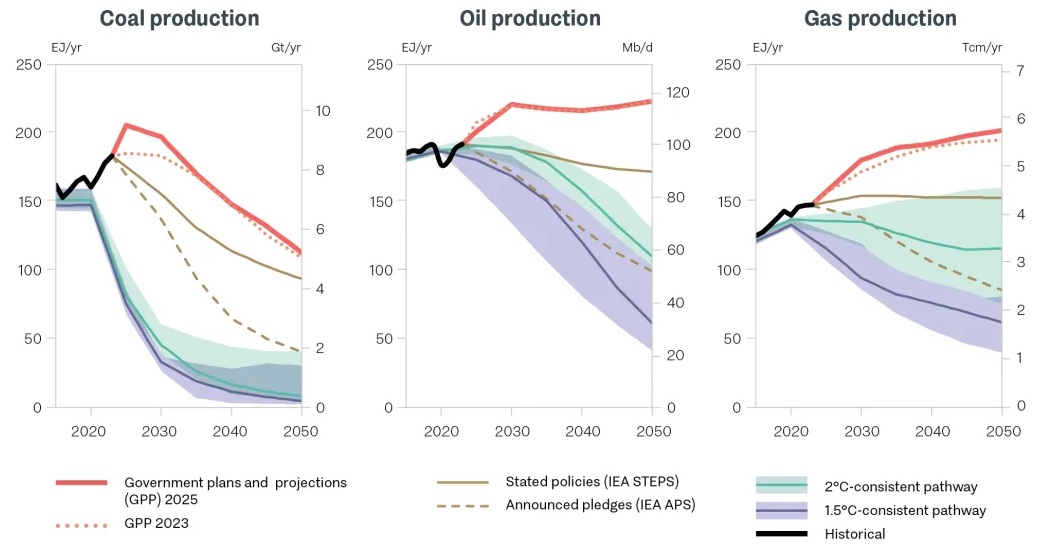
Governments, in aggregate, still plan to produce more than double the amount of fossil fuels in 2030 than would be consistent with limiting warming to 1.5°C. Taken together, governments now plan even higher levels of coal production to 2035, and gas production to 2050, than they did in 2023. Planned oil production continues to increase to 2050. These plans undermine countries’ Paris Agreement commitments, and go against expectations that under current policies global demand for coal, oil, and gas will peak before 2030.
As nations submit their domestically defined contributions in advance of the annual United Nations climate summit in November in Belém, Brazil, the 2025 Production Gap Report is released. The purpose of National Determined Contributions (NDCs) is to demonstrate how far nations have come in meeting the Paris Agreement‘s targets to drastically cut down on the human sources of greenhouse gases that warm the earth.
NPR: “In particular, the near-term gap has increased with projected 2030 production exceeding levels consistent with 1.5 degrees [Celsius] by more than 120%, up from 110% in 2023,” Derik Broekhoff, senior scientist at SEI and report co-author, said on a call with reporters.
China is driving much of the increase, according to the report, because it now plans to reduce coal production more slowly through 2030 than it did in the 2023 Production Gap Report. “And China, because it represents over half of total global coal production, drives a lot of those numbers,” Broekhoff says. Among fossil fuels, coal is the dirtiest in terms of climate pollution.
“The reality is stark,” says Melanie Robinson, global climate director at the World Resources Institute. During a recent presentation, she said countries reviewed their progress at the 2023 UN climate meeting in Dubai and found they need to move away from fossil fuels, triple renewables, double energy efficiency, end deforestation and cut transportation pollution. “And this wasn’t a wish list — it’s a to-do list. Countries pledged to it in Dubai, so now it is time to deliver,” she says.
Climate policy
Policies implemented by the Trump administration to increase the production of fossil fuels in the United States and restrict the use of cleaner electricity sources like solar and wind are not included in this study. It is predicated on information gathered during President Biden’s administration.
The nation’s energy and climate policies are changing as a result of Trump’s flurry of executive orders and regulations, but such changes won’t materialize anytime soon. Under legislation enacted under the Biden administration, state and local governments continue to implement policies centered on the objectives of the Paris Agreement and investments that businesses have already committed.
NPR: “The level of impact that the Trump administration is able to have on global climate is still an open question,” says Neil Grant, analyst at Climate Analytics and co-author of the report.
Trump has already started the process to pull the U.S. out of the Paris Agreement, something he did during his first term in office. His administration has proposed a series of policy changes, including repealing climate pollution limits on fossil fuel power plants, reversing a 2009 finding that climate pollution harms people and eliminating climate pollution limits on vehicles.
The top U.S. environmental regulator has touted the administration’s efforts to roll back plans to address climate change.
“We are driving a dagger straight into the heart of the climate change religion to drive down cost of living for American families, unleash American energy, bring auto jobs back to the U.S. and more,” Lee Zeldin, administrator of the Environmental Protection Agency said in March, when he announced rollbacks.
Grant says Trump’s effect on the world’s climate efforts will depend on whether other countries choose to follow the President’s lead.
“We saw in 2016 to 2020 that Trump tried to kill climate action and tried to kill the Paris Agreement,” Grant says. “He hasn’t succeeded. I’m confident that he won’t succeed again.”
Even while this research indicates that they are not on track to meet the goals in the Paris Agreement, for the time being, the majority of nations are upholding their obligations to do so. According to the report’s authors, accomplishing that now will necessitate a future reduction in the production and consumption of fossil fuels that is even more drastic.
About the Author: CLIMATE STATE

POPULAR
COMMENTS
- The risk with the path to a hothouse Earth | Climate State on Climate Tipping Points Existential Threat to Our Life Support Systems
- Robert Schreib on Electricity generation prices may increase by as much as 50% if only based on coal and gas
- Robert Schreib on China made a historic commitment to reduce its emissions of greenhouse gases
- Lee Nikki on COP30: Climate Summit 2025 – Intro Climate Action Event
- Hollie Bailey on Leaders doubled down on fossil fuels after promising to reduce climate pollution
The article talks about how countries are still planning to produce too much fossil fuel, which is bad for climate change. Even though there are goals to reduce pollution from ten years ago, many nations are increasing their coal and oil production instead of cutting it down. This is concerning because it shows they might not keep their promises from the Paris Agreement. We need to focus more on clean energy and really work on reducing fossil fuel use.